
By Angelo Meda, Head of Equities at Banor
How to invest when the markets’ satnav keeps ‘recalculating the route’.
In theory, financial markets love certainty. In practice, they spend a good part of their time trying to predict events that no one can foresee, and then attach great importance to forecasts that may well be revised the following month. It is a curious line of work: precision to the decimal point is demanded in a world that changes its mind before it has even finished its sentence.
In recent weeks, the only real certainty has been uncertainty. We do not know where the oil price will settle, we do not know how high interest rates will go, and we do not know which direction European politics will take after the recent German election results, with many more elections on the horizon. What we do know, on the other hand, is that every new piece of information will immediately be turned into a market move – preferably one far larger than the news deserves.
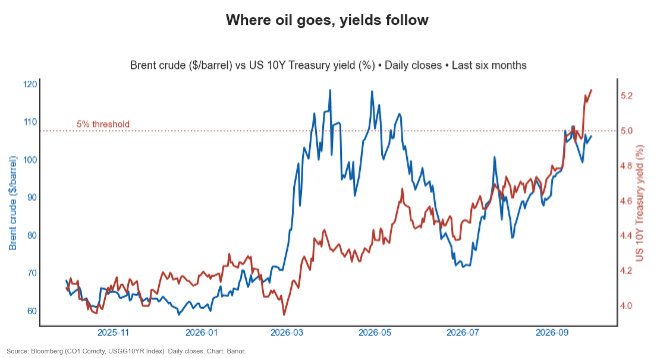
Despite everything, world stock markets have shown a remarkable ability to adapt. The global equity index is heading for its best week since the start of August, buoyed by enthusiasm for artificial intelligence and by hopes of improved energy supplies from the Middle East. Europe has regained ground, and Wall Street continues to trade not far from its highs. Beneath the surface, however, the bond market tells a much less relaxed story, with the yield on the 10-year US Treasury above 5%, while eurozone government bond yields have been rising for several weeks. On paper, the situation might appear stable, but it would be premature to call it calm.
The first big unknown concerns oil. In recent weeks, Brent first climbed above $109 a barrel, then fell back towards $100 on the prospect of easing tensions in the Middle East and a possible reopening of flows through the Strait of Hormuz. The problem is that between $100 and $109, it is not just the cost at the pump that changes, but also inflation expectations, central bank decisions, corporate margins and consumers’ disposable income.
When oil rises, inflation fears return, bond yields go up and the most rate-sensitive stocks suffer. When it falls, it takes just a few sessions for investors to start talking again about disinflation, future rate cuts and a soft landing. All this while the geopolitical picture can change between the European open and the Wall Street open. Energy uncertainty does not necessarily suggest chasing oil after every rally, but rather asking which companies can protect their margins if energy stays expensive, and which, instead, have built their targets on the assumption that everything will quickly return to normal.
The second uncertainty concerns monetary policy. In September, the Federal Reserve raised rates by 25 basis points, taking the federal funds target range to 3.75–4.00%. A few days earlier, the European Central Bank had also raised its deposit rate to 2.50%, explaining that energy pressures will keep inflation above target for longer than expected. What is genuinely new is not the individual hike but the shift in expectations. For months, investors asked themselves how quickly central banks would cut rates. Now the question has suddenly become a different one: how many more hikes will be needed and, above all, where does the new ‘neutral’ level lie?
The answer is not academic. With the risk-free yield above 5%, every investment has to justify its price with greater conviction. Expensive stocks must deliver real growth, private equity can no longer rely solely on leverage, and real estate has to refinance its debt on less favourable terms.
Equity markets, however, are reacting selectively: technology and AI-related stocks continue to benefit from growing investment, while more heavily indebted companies, or those whose earnings lie far in the future, are feeling the rising cost of capital more keenly.
The third source of uncertainty comes from politics. September’s regional elections in Germany showed a sharp weakening of the traditional parties, sending a significant political message: in Germany, the centre is being eroded, just as the country has to contend with high energy costs, an ageing population, industrial weakness and growing Chinese competition.
For markets, the issue is not only who wins elections; what matters above all is the ability to build stable majorities, pass reforms and maintain fiscal credibility. A more politically fragile coalition could slow down the necessary action or resort to spending measures that are more popular in the short term but less sustainable in the long term. Germany, once considered reliable, now appears less stable and more unpredictable.
How do you invest when you do not know the ending? The solution is not to predict every single event better, but to build portfolios that do not depend on a single outcome, favouring companies with solid balance sheets, strong cash generation and pricing power. It also means diversifying not only across many securities, but across different return drivers, such as structural growth, dividends, bond carry, infrastructure, real assets and company-specific situations. Cash, too, regains its value as a reserve of flexibility, making it possible to turn corrections into opportunities.
We do not know the exact route events will take, but we do know that companies will keep investing, consumers will keep adapting and markets will keep trying to anticipate the future. In this environment, the fund manager’s job is not to eliminate uncertainty, but to prevent a single wrong forecast from jeopardising the entire journey.
This communication is issued by Banor Capital Limited which is authorised and regulated by the Financial Conduct Authority (FRN: 523080). For Professional Clients and Eligible Counterparties only. Not for Retail clients. The content is for information purposes only and does not constitute investment advice, a recommendation, or an offer/solicitation to buy or sell any investment. Views are those of the speaker and may change. Any views expressed regarding future market conditions, sector performance, or investment returns are forward-looking statements and may not materialise. Actual outcomes may differ materially. Forecasts are not a reliable indicator of future performance. This communication is not directed to any person in any jurisdiction where doing so would be unlawful; distribution may be restricted.
Angelo Meda is Head of Equities at Banor SIM S.p.A. and provides research and advisory input to Banor Capital Ltd pursuant to an advisory agreement.
This article is an English translation of an article originally prepared and published by Banor SIM.