
By Angelo Meda, Head of Equities at Banor
Wall Street retreats, but earnings estimates hold up
Technology has rarely dominated the headlines as much as it has in recent weeks: a spy scandal that engulfed the founder of the AI chip giant, the largest IPO in history, silent inboxes, grounded aircraft, and inaccessible bank accounts. Actual numbers, meanwhile, have received far less attention, and those that did appeared deep in the fine print. At the same time, stock indices have fallen while earnings estimates have risen. So who is right: the market’s instinct or the analysts’ thermometer?
On 12 November, Jensen Huang, who founded Nvidia in 1993, resigned as Chief Executive Officer, President, and member of the Board. Following revelations of an extramarital relationship with an executive alleged to have links to Chinese intelligence, Nvidia shares fell as much as 14% in early trading, wiping out more than $400 billion in market value. Then came the actual results on 17 November: quarterly revenues of $115.8 billion, more than double the previous year and above expectations; guidance of $130 billion for the current quarter; and expected growth for the next fiscal year raised from 70% to 75%.
In another era, this would have been the financial story of the year. Instead, the after-hours rally faded during the following session, and by Friday the stock had fallen another 13.8%, taking the total decline since the scandal broke to more than 25%. More attention was paid to spies than to profit margins.
The second major event was the IPO of Anthropic, the developer of Claude. The offering price was set at $83, above the indicated range of $70-78, with 980 million shares outstanding, implying a valuation of roughly $81 billion, the largest IPO ever. Trading began on 19 November with fireworks: the stock opened at $111.50 (+34%), though it finished the day at $97.17 (+17%), suggesting that investors were enthusiastic but cautious. By Friday the shares had fallen another 9.1%, to $88.30, still above the IPO price but already 23% below the intraday high reached on debut.
Anyone with a 3kW electricity meter knows what happens if the oven, dishwasher, and hair dryer are switched on simultaneously: the power trips. In the United States, something similar happened three times in a single week.
On 12 November, the same day Huang resigned, Outlook, Teams, and Copilot were unavailable for more than twelve hours. Microsoft cited excessive server loads and ruled out a cyberattack, despite serving approximately 430 million users.
The following day, the Federal Aviation Administration halted all departures nationwide for more than four hours after an air traffic control communications failure, leading to over 9,000 flight cancellations on Friday alone. The Transportation Secretary blamed overloaded routers and switches in an ageing network.
Then on 16 November, customers of JPMorgan Chase, Bank of America, Wells Fargo, and other major banks were unable to access their online accounts, with Chase attributing the outage to a technical issue.
These were three different incidents, with no confirmed cyberattack and no officially identified common cause. Yet the common thread is obvious: an increasingly digital economy runs on infrastructure that is not always expanding as quickly as demand. The same issue emerged on Nvidia’s earnings call, where CFO Colette Kress linked forecasts to the availability of fully operational data centres, with land and energy supply among the key constraints.
For investors, this is not a trivial matter. Strengthening infrastructure, from networks and power grids to cybersecurity, represents an enormous investment requirement. Someone will have to pay for it, and someone else will profit from it.
If the smoke fills the newspapers, the substance is found in the spreadsheets.
On Friday, the S&P 500 fell 3.7% to 6,910, its seventh consecutive losing session, the longest such streak since the start of the pandemic and its worst week since April 2025. The index is officially in correction territory, down more than 11% from its 6 October high and essentially flat for the year.
The Nasdaq lost 5.3% in a single session, slipped into negative territory for 2026, and sits roughly 18% below its peak, within touching distance of a bear market. The semiconductor index fell nearly 11% in one day.
Yet earnings estimates have held firm. In fact, since the end of September analysts have increased fourth-quarter earnings-per-share forecasts by 1.1%, even though estimates typically fall as a quarter progresses. Third-quarter earnings growth is now expected to come in at nearly 32%.
The result is that valuation multiples have deflated like a soufflé removed from the oven too soon. The market has gone from trading at 22 times forward earnings at the start of the year to 16.5 times on Friday.
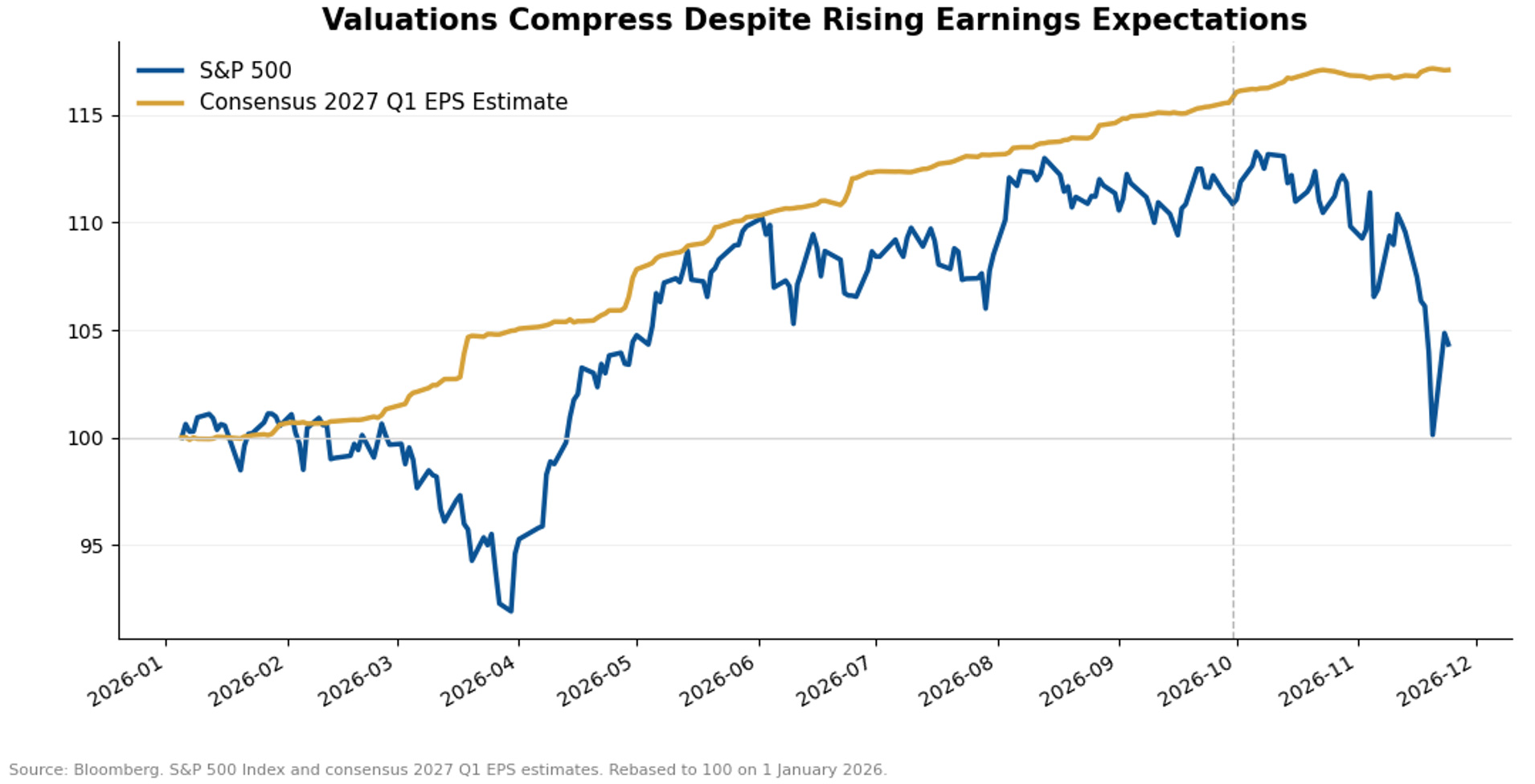
Yet markets have a habit of questioning the “all smoke, no fire” narrative. Prices often fall before earnings estimates do, because analysts typically revise forecasts only after market sentiment has already changed.
The clearest comparison is 2022. Like today, that market decline was initially driven more by interest rates than by an economic crisis, and the first half of the year bears a strong resemblance to recent weeks. Between 3 January and 12 October, the S&P 500 fell 25.4%; the market multiple contracted by 30%, while expected earnings actually rose by 6%.
Analysts only began cutting forecasts in June and continued until February 2023, four months after the market bottom.
Yet there is a second lesson, one less frequently mentioned. In 2022, the market was correct about the direction of earnings revisions but wrong about their severity, pricing in an earnings recession that never materialised.
Today, three signals stand out.
The first is the cost of money. The Federal Reserve meets on 8-9 December, and futures markets assign a very high probability to another rate increase.
The second is slowing growth, with forecasts beginning to decelerate.
The third is politics. The midterm elections have introduced uncertainty around the pace of data-centre investment.
The market is not saying that earnings will decline. It is saying that those earnings are worth less. However, on Friday investors also began pricing in the possibility that profit growth among AI infrastructure suppliers could eventually stall.
The debate has therefore shifted. A few months ago the question was how much AI would grow. Today the question is when spending on building AI infrastructure will stop growing.
Back in early October, Wells Fargo argued that after third-quarter earnings and the midterms, investors would start focusing on whether 2027 might represent a peak year for AI-related investment spending. The election strengthened candidates favouring a slower pace of data-centre construction, and some observers now expect investment growth to peak in 2027 rather than 2028.
As Michael Antonelli of Baird put it on Friday, the idea that AI spending can expand indefinitely and support equity markets forever is fading, although that does not necessarily imply the end of the bull market that began in October 2022.
It is important, however, to understand what “peak” means.
Spending by the major U.S. cloud providers is expected to rise from roughly $800 billion in 2026 to $1.2 trillion in 2027. Growth would slow to 54%, and then to 12% in 2028.
History provides an example. In 2000, Cisco peaked while its revenues were still growing at extraordinary rates, before losing 86% over the following nineteen months. Markets sometimes recognise future earnings slowdowns long before they become visible in the reported numbers.
There is one final detail that investors often overlook: peak investment spending is bad news for those selling hardware, but it can be good news for those buying it.
According to estimates, this year spending by Oracle, Microsoft, Amazon, Meta, and Alphabet will, for the first time, exceed the cash they generate from operations. Once capital expenditure growth begins to moderate, cash flow will return to these companies along with the share buyback programmes that Meta and Alphabet suspended earlier this year.
Within portfolios, the distinction between who sells the tools and who buys them may matter far more than the generic label of “artificial intelligence.”
This week Americans will sit down for Thanksgiving, marking the beginning of what statistics suggest is the most favourable period of the year for equities. Historically, December is one of the strongest months for the S&P 500.
Before the final seasonal window between 24 December and 5 January, however, investors should focus on three dates.
First, 9 December, when Fed Chair Kevin Warsh is expected to deliver another rate increase. Markets will pay closest attention to the updated projections. The Federal Reserve must lower the heat enough to prevent inflation from burning the turkey, without leaving it undercooked.
Second, Anthropic, which is on track to join the Nasdaq 100 on 21 December.
Third, Nvidia, which still needs to appoint a permanent CEO and convince investors that its results are not dependent on who sits at the head of the table.
So, is it all smoke and no fire?
In a few weeks, investors may have their answer. The recent sell-off could prove to have been little more than headlines obscuring resilient fundamentals. Or it may turn out that the market had already caught the first hint of smoke before the fire became visible in earnings estimates.
For now, the smoke is easy to see. Whether there is a fire behind it remains the question that matters.
This communication is issued by Banor Capital Limited which is authorised and regulated by the Financial Conduct Authority (FRN: 523080). For Professional Clients and Eligible Counterparties only. Not for Retail clients. The content is for information purposes only and does not constitute investment advice, a recommendation, or an offer/solicitation to buy or sell any investment. Views are those of the speaker and may change. Any views expressed regarding future market conditions, sector performance, or investment returns are forward-looking statements and may not materialise. Actual outcomes may differ materially. Forecasts are not a reliable indicator of future performance. This communication is not directed to any person in any jurisdiction where doing so would be unlawful; distribution may be restricted.
Angelo Meda is Head of Equities at Banor SIM S.p.A. and provides research and advisory input to Banor Capital Ltd pursuant to an advisory agreement.
This article is an English translation of an article originally prepared and published by Banor SIM.