
By Angelo Meda, Head of Equities at Banor
Wall Street takes centre stage, alongside artificial intelligence and oil, with central banks behind the camera
Summer is traditionally blockbuster season: lavish budgets, spectacular special effects, seemingly invincible heroes and audiences who have already decided whether a film will be a masterpiece before they have even bought their popcorn. This year, financial markets appear to be following the same script.
Expectations have become an integral part of the spectacle. Delivering good results is no longer enough: companies must impress an audience that has already watched the trailer, read the previews and priced in the sequel. In recent weeks, action sequences, geopolitical suspense, moments of apparent calm and sudden changes in the leading cast have followed one another in rapid succession.
The main plot, however, has not changed. Global economic growth is slowing, but for the time being it shows no intention of leaving the stage. Corporate earnings remain solid, while investment in artificial intelligence continues to increase. The problem is that audiences have become demanding: when ticket prices are high, the film itself has to be flawless.
The opening scene naturally takes place on Wall Street. US indices had enjoyed a long positive run, supported by the belief that the economy could navigate the slowdown without slipping into recession. Then earnings season began, and investors turned from enthusiastic spectators into exceptionally demanding film critics.
Overall, the initial results were very strong. More than 80% of the companies that have reported so far have exceeded both earnings and revenue expectations. Yet many of the market reactions have been muted or openly negative. This is the paradox of today’s market: a film may be excellent, but when everyone is expecting the next Godfather, even a very good production can receive disappointing reviews.
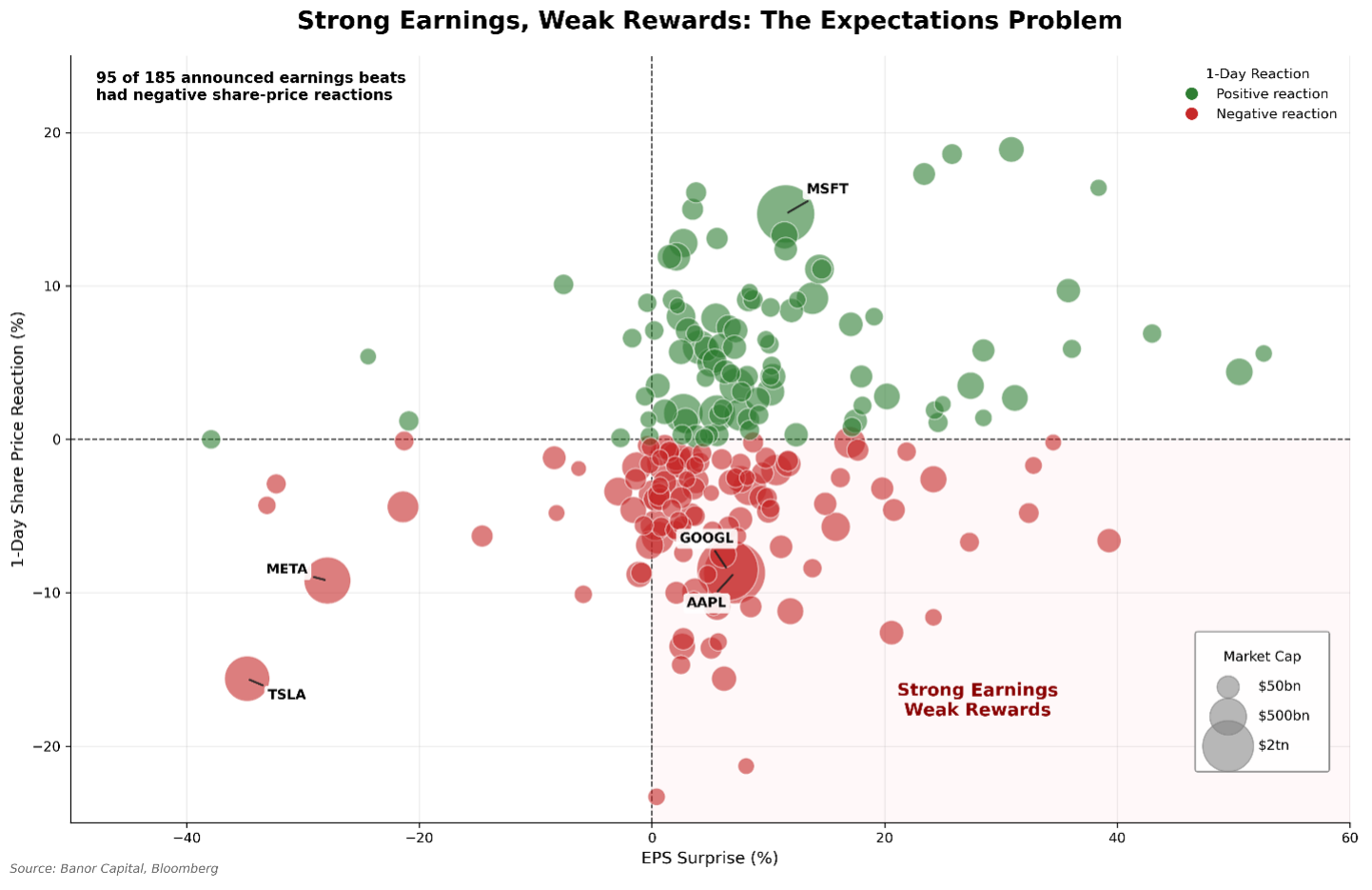 Alphabet provided the clearest example. Google Cloud reported revenue growth of 82%, demonstrating that demand for computing capacity linked to artificial intelligence is far from imaginary. The market, however, focused on the increase in the company’s projected capital expenditure for 2026, now expected to reach $195–205 billion, and on the first negative quarter in its history. In other words, the audience applauded the special effects but immediately began wondering who would pick up the bill.
The result was a more difficult week for the technology sector. This is not yet a rush for the exits: all the main US indices remain in positive territory since the beginning of the year. It is more of an interval, during which the audience is trying to decide whether the second half of the film will justify the cost of its production.
Every respectable blockbuster needs an action sequence. This time, oil provided it.
Tensions in the Middle East brought the risk of supply disruptions back into focus, temporarily pushing Brent crude above $100 a barrel. Suddenly, a film that had appeared to be entirely about artificial intelligence changed genre, turning into an inflation thriller.
Higher oil prices make the task facing central banks more complicated. They support energy companies, but also increase costs for businesses and households, potentially slowing the disinflation process. Tariffs have also returned to the screen, a recurring character that audiences had hoped had been written out in previous seasons, but that the scriptwriters—one in particular—continue stubbornly to bring back.
Bond yields reacted nervously, weighing particularly heavily on growth stocks, which are more sensitive to the cost of capital. The message is simple: artificial intelligence may promise a wonderful future, but in the present, servers, energy and data centres still need to be paid for.
Attention is now shifting to the Federal Reserve meeting on 28 and 29 July. The market would like an accommodating director, willing to cut interest rates and guarantee a happy ending. As is often the case, however, the Fed may opt for a more contemplative shot: watching the data, repeating the word “patience” a dozen times and leaving investors to interpret the subtext.
Meanwhile, on the other side of the world, the film takes on the style of a financial anime, with immensely powerful protagonists, extreme movements and semiconductors apparently battling for the fate of the universe.
South Korea, Taiwan and Japan have become the industrial heart of the artificial-intelligence revolution. For precisely this reason, they are also particularly exposed to changes in investor sentiment. In mid-July, even exceptional results from TSMC, whose quarterly earnings rose by 77%, were not enough to prevent a sharp correction across the sector.
This does not appear to be the end of the semiconductor story. Rather, the market is rewriting the script, distinguishing between the companies genuinely benefiting from AI demand and the supporting actors that have simply inserted the words “artificial intelligence” into every corporate presentation.
After extraordinary gains, particularly in the South Korean and Taiwanese markets, profit-taking was almost inevitable. Foreign investors sold more than $137 billion of Asian equities in the first half of the year, but these flows appear primarily to reflect portfolio rebalancing and efforts to reduce concentration, rather than a definitive abandonment of the theme.
The AI revolution remains intact, but audiences have started asking for fewer special effects and more evidence of returns on invested capital.
After the American car chases and the Asian battles, Europe offers a calmer scene, with more balanced markets supported by banks, industrial companies and the energy sector. SAP has provided a reminder that the Old Continent also has credible technology leaders, thanks to solid cloud-related results. The environment nevertheless remains highly selective: while some companies are rewarded, others suffer severe corrections at the slightest sign of weakness.
Economic data also delivered a positive surprise. The eurozone composite PMI rose to 51.9 in July, returning to expansionary territory for the first time in four months. Both services and manufacturing contributed to the improvement, with the latter reaching its highest level in more than four years.
Europe may not be the character dominating the promotional poster, but it could prove to be the one that holds the plot together. Less demanding valuations, improving earnings revisions and a more diversified sector composition make it a useful counterweight to the concentration of the US market in technology stocks.
This brings us to the scene immediately before the finale. Fundamentals remain constructive, but elevated valuations leave less room for error. The growth of artificial intelligence is real, but the market now wants to see returns from the enormous investments that have been made. Oil is threatening to reignite inflation, but prices could fall rapidly if geopolitical tensions ease. The economy is slowing, but it continues to create jobs and support corporate earnings.
Dispersion among individual stocks has also increased. This has made the indices more complicated to navigate, but potentially created a more attractive environment for investors selecting companies one by one. After years dominated by sweeping macroeconomic narratives, stock-picking appears to have secured a speaking role once again.
Microsoft, Meta and Amazon will have to demonstrate that the race to invest in AI is generating growth, rather than merely producing highly imaginative invoices for GPU purchases. The Federal Reserve will have to decide whether to reassure the audience or keep the suspense alive. Oil, tariffs and geopolitics will continue to move in the background.
For now, earnings are still growing, investment remains high, the economy is resilient and market sentiment continues to be positive.
After the rally recorded by the indices so far, a degree of caution would not go amiss. The rest of the script has yet to be written, but further plot twists may be just around the corner.
This communication is issued by Banor Capital Limited which is authorised and regulated by the Financial Conduct Authority (FRN: 523080). For Professional Clients and Eligible Counterparties only. Not for Retail clients. The content is for information purposes only and does not constitute investment advice, a recommendation, or an offer/solicitation to buy or sell any investment. Views are those of the speaker and may change. Any views expressed regarding future market conditions, sector performance, or investment returns are forward-looking statements and may not materialise. Actual outcomes may differ materially. Forecasts are not a reliable indicator of future performance. This communication is not directed to any person in any jurisdiction where doing so would be unlawful; distribution may be restricted.
Angelo Meda is Head of Equities at Banor SIM S.p.A. and provides research and advisory input to Banor Capital Ltd pursuant to an advisory agreement.
This article is an English translation of an article originally prepared and published by Banor SIM.